Respirator vs mask
- N95 filtering facepiece respirator: NIOSH-approved to filter at least 95% of airborne particles when it seals to your face. It protects the wearer from inhaling small particles like TB droplet nuclei.
- Surgical (medical) mask: a loose-fitting barrier that blocks splashes and catches the wearer's own respiratory particles. It doesn't seal and isn't a respirator.
- Powered air-purifying respirator (PAPR): a battery-powered blower pushes filtered air into a hood or facepiece. Useful when someone can't pass a fit test, has facial hair, or for higher-risk procedures.
Look for the NIOSH approval printed on the respirator (and on NIOSH's approved list). Counterfeit N95s exist.
OSHA's respiratory protection program
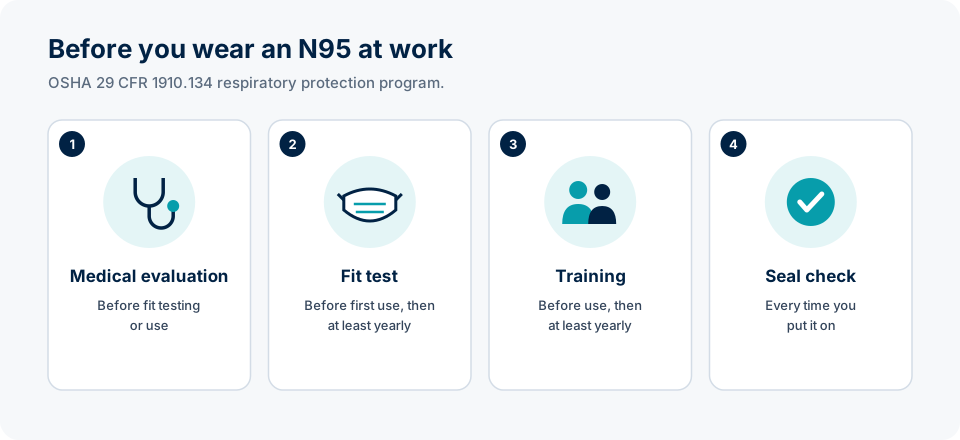
When respirators are needed to protect workers, OSHA's Respiratory Protection Standard (29 CFR 1910.134) requires the employer to have a written program that includes:
- Medical evaluation before you're fit tested or use a respirator (1910.134(e)), usually a confidential questionnaire reviewed by a licensed health care professional.
- Fit testing with the exact make, model, style and size you'll wear, before first use, whenever you switch to a different respirator, and at least annually (1910.134(f)). Also re-test after changes like significant weight change, dental work or facial surgery that could affect the fit.
- Training before use and at least annually (1910.134(k)): why the respirator is needed, its limits, how to put it on and check the seal, maintenance and storage.
- Procedures for selection, use, cleaning and storage, and for evaluating the program.
Facial hair
Tight-fitting respirators may not be worn when facial hair comes between the sealing surface and the face (1910.134(g)(1)(i)). Options include shaving the seal area, a style that keeps hair out of the seal, or a loose-fitting PAPR. Religious accommodations are usually handled with a PAPR.
This course teaches the concepts. It is not a fit test or medical evaluation; your employer provides those for the respirators you'll use.
Key terms · tap to flip
Check your understanding
Knowledge check
Pick an answer to see the explanation. Get them all right to complete the lesson.
Part of the free MedRise TB & Respiratory Protection Training. Built on the CDC/NTCA 2019 health care personnel TB recommendations, CDC TB infection control guidance and OSHA 29 CFR 1910.134.