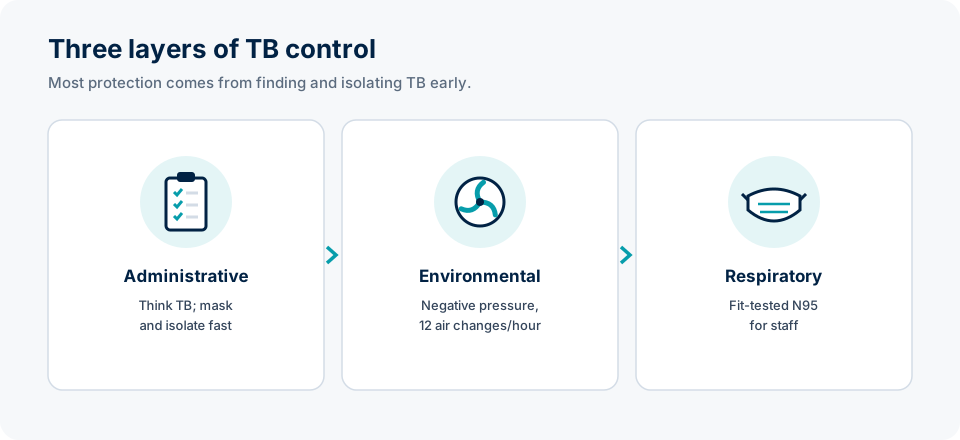
The hierarchy of TB controls
- Administrative controls reduce the chance that anyone is exposed: a written TB infection control plan, screening patients for TB symptoms at triage, prompt isolation and testing, and training staff.
- Environmental controls reduce the concentration of infectious particles: ventilation, airborne infection isolation rooms, HEPA filtration, and in some settings ultraviolet germicidal irradiation.
- Respiratory protection protects the individual worker in areas where exposure may still happen.
When you suspect TB
- Give the patient a surgical mask and tissues, and ask them to cover coughs.
- Place them in an AIIR as soon as possible; if none is available, a private room with the door closed while transfer is arranged, per your facility's plan.
- Notify infection prevention and the care team, and order the diagnostic workup.
- Limit transport out of the room; when it's necessary, the patient wears a surgical mask.
Who wears what: the patient wears a surgical mask to catch what they cough out. You wear a fit-tested N95 (or higher) to filter what you breathe in. A surgical mask on staff does not protect against TB.
How an AIIR works
- Negative pressure: air flows into the room from the hallway, not out. Many rooms have a pressure monitor at the door; check it.
- Air changes: CDC's 2005 guidelines call for at least 12 air changes per hour in new or renovated AIIRs, and at least 6 in existing ones.
- Exhaust: air goes directly outside away from intakes and people, or through HEPA filters before recirculation.
- Door closed: an open door breaks the pressure difference.
When isolation can stop
Infection prevention decides. Under CDC guidance, airborne precautions for suspected or confirmed infectious TB continue until TB is ruled out or, for confirmed TB, the patient is on effective treatment, improving clinically and has three consecutive negative sputum smears.
Key terms · tap to flip
Check your understanding
Knowledge check
Pick an answer to see the explanation. Get them all right to complete the lesson.
Part of the free MedRise TB & Respiratory Protection Training. Built on the CDC/NTCA 2019 health care personnel TB recommendations, CDC TB infection control guidance and OSHA 29 CFR 1910.134.