What changed in 2019
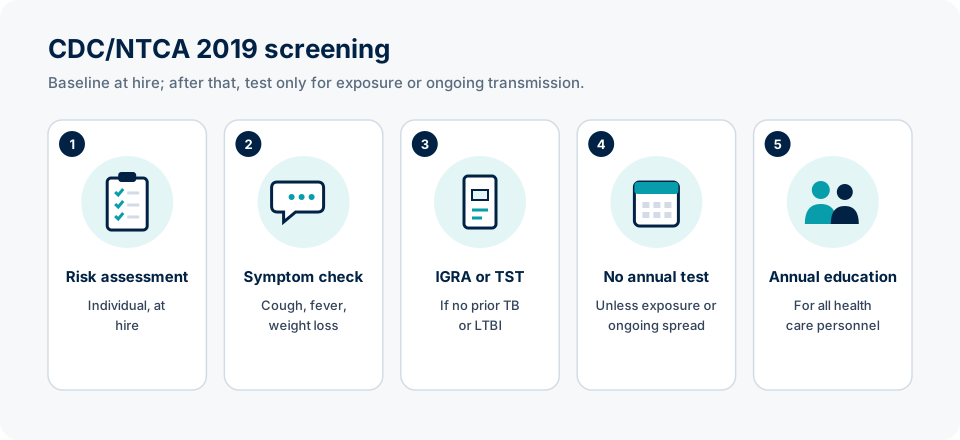
In May 2019, CDC and the National Tuberculosis Controllers Association updated the 2005 recommendations for screening U.S. health care personnel. U.S. TB rates have fallen, and serial testing of low-risk workers produced many false positives. The update:
- Baseline (pre-placement) screening for everyone: an individual TB risk assessment, a symptom evaluation, and a TB test (an interferon-gamma release assay, IGRA, or a tuberculin skin test, TST) for people without documented prior TB disease or LTBI.
- No routine serial testing at any interval after baseline (for example annually) in the absence of a known exposure or ongoing transmission.
- Treatment encouraged for all health care personnel with untreated LTBI, unless it's contraindicated.
- Annual symptom screening for those with untreated LTBI.
- Annual TB education for all health care personnel.
- Facilities may still choose serial testing for some groups at higher occupational risk, such as pulmonologists or respiratory therapists, or settings with ongoing transmission.
Check your local rules: CDC's recommendations don't override state or local regulations, which may still require periodic testing. Your employer's TB plan tells you what applies to you.
IGRA or skin test?
- IGRA (a blood test): one visit, and it isn't affected by prior BCG vaccination, so it's often preferred for people who received BCG.
- TST (skin test): injected in the forearm and read 48 to 72 hours later by a trained person. A two-step TST is used at baseline in some settings.
A positive test means infection, not necessarily disease. The next step is a symptom review and a chest X-ray to rule out active TB, and then a discussion of LTBI treatment.
BCG vaccine
Many IMGs and people born outside the U.S. received BCG as children. BCG can cause a false-positive skin test, which is a reason IGRA is often used. A history of BCG doesn't mean you're protected from TB as an adult.
Key terms · tap to flip
Check your understanding
Knowledge check
Pick an answer to see the explanation. Get them all right to complete the lesson.
Part of the free MedRise TB & Respiratory Protection Training. Built on the CDC/NTCA 2019 health care personnel TB recommendations, CDC TB infection control guidance and OSHA 29 CFR 1910.134.