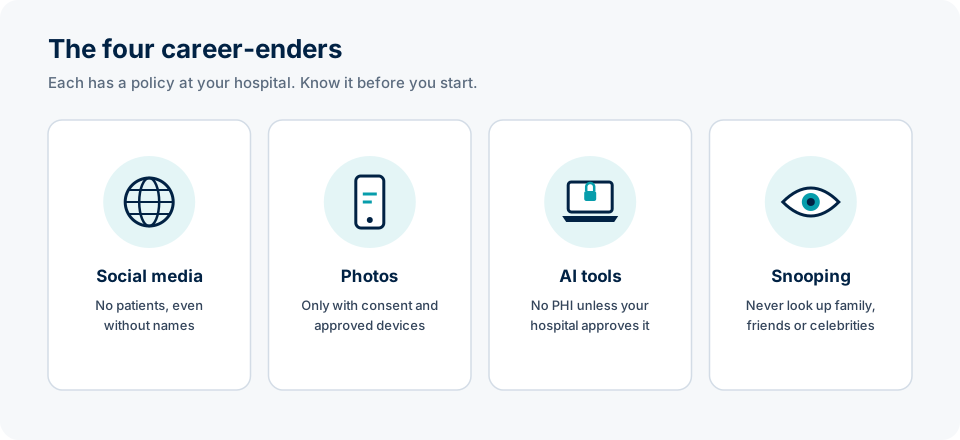
Social media
Most HIPAA trouble for trainees isn't hacking. It's a post. A “nameless” story about a dramatic case, a selfie with a whiteboard behind you, or a comment about a famous patient can identify someone. Even well-meant posts, like celebrating a recovery, need the patient's written authorization and usually go through the hospital's communications office.
Rule of thumb: if the patient, their family or a coworker could recognize them, don't post it. And check what's in the background of every photo you take at work.
Photos and video
Clinical photos, such as wound documentation, are PHI. Follow your hospital's policy: patient consent, an approved device or app, and storage in the medical record, not on your camera roll. For teaching or publication, get the written consent your institution and the journal require.
AI tools
Typing PHI into a public chatbot sends it to a company that is usually not the hospital's business associate. Use only AI tools your organization has approved for PHI (which typically means a business associate agreement is in place). For studying, write your own made-up case or remove all 18 identifiers first.
Snooping
Opening a chart you don't need for your work violates the minimum necessary standard and hospital policy, even if you never tell anyone what you saw. That includes:
- Your own family members, friends, classmates and coworkers
- Celebrities, local news stories and VIP patients
- Your own chart through the clinical system (use the patient portal like everyone else)
Audit logs record every look. Hospitals review access to high-profile records, and workforce members have been fired, and in some cases prosecuted, for snooping.
Talking about patients
Teaching conversations on rounds are part of operations. The same conversation in the elevator, cafeteria or on a group chat is not. Keep identifiers out of public spaces and personal messaging.
Key terms · tap to flip
Check your understanding
Knowledge check
Pick an answer to see the explanation. Get them all right to complete the lesson.
Part of the free MedRise HIPAA Privacy & Security Training. Built on the HIPAA Privacy, Security and Breach Notification Rules (45 CFR Parts 160 and 164).