What counts as a breach
A breach is the acquisition, access, use or disclosure of PHI in a way the Privacy Rule doesn't permit, which compromises its security or privacy (45 CFR 164.402). Examples: a fax to the wrong number, a lost unencrypted laptop, an email to the wrong patient, a snooping coworker, a hacked account.
Presumed breach, unless...
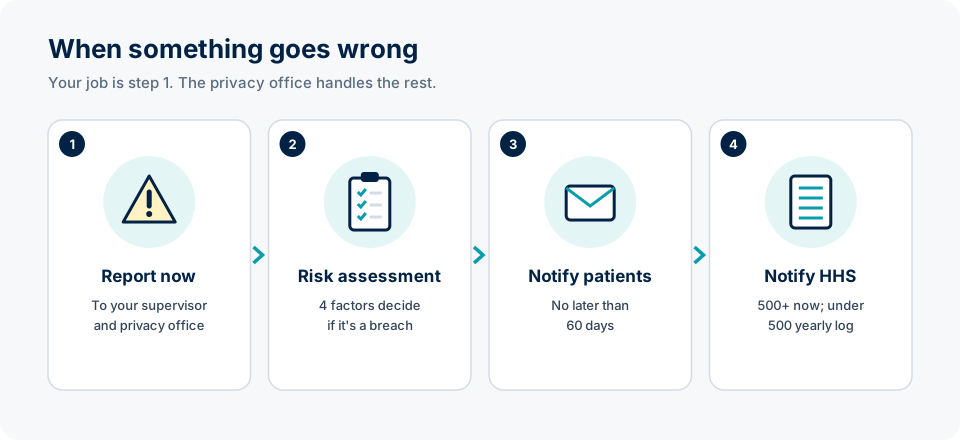
An impermissible use or disclosure is presumed to be a breach unless the organization shows, through a documented assessment, a low probability that the PHI was compromised. It weighs four factors:
- The nature and extent of the PHI involved (how sensitive, how identifiable)
- Who received or used it
- Whether it was actually acquired or viewed
- How well the risk was mitigated (for example, a signed statement that it was destroyed)
There are three narrow exceptions, such as an unintentional, good-faith access by a workforce member acting within their job that goes no further.
Notification deadlines
- Individuals: without unreasonable delay and no later than 60 calendar days after discovery (164.404).
- Media: if more than 500 residents of a state or jurisdiction are affected (164.406).
- HHS: for 500 or more people, at the same time as individuals; for fewer than 500, in a log submitted within 60 days after the end of the calendar year (164.408).
- Business associates must notify the covered entity, within 60 days of discovery.
Why speed matters: the 60-day clock starts when the breach is known to anyone in the workforce other than the person who caused it, or would have been known with reasonable diligence. A student who notices a misdirected fax and says nothing can make the hospital late.
What to do in the moment
- Stop the problem if you safely can (retrieve the paper, recall the email, ask the recipient not to open it).
- Report immediately to your supervisor and the privacy or compliance office, following your organization's process.
- Don't investigate, contact the patient or delete evidence yourself.
Reporting in good faith is protected. Hiding a mistake is what turns it into discipline.
Key terms · tap to flip
Check your understanding
Knowledge check
Pick an answer to see the explanation. Get them all right to complete the lesson.
Part of the free MedRise HIPAA Privacy & Security Training. Built on the HIPAA Privacy, Security and Breach Notification Rules (45 CFR Parts 160 and 164).