The one-liner
“Mr. Lee is a 68-year-old man with heart failure with reduced ejection fraction and type 2 diabetes, admitted yesterday with 3 days of worsening shortness of breath, consistent with acute decompensated heart failure.” One sentence tells the team who the patient is and why they're here.
A tight oral presentation (follow-up day)
- Subjective: overnight events and how the patient feels today, in a sentence or two.
- Objective: vitals with trends, focused exam, key labs and imaging. Don't read every number; say what changed.
- Assessment and plan, by problem: “#1 Acute decompensated heart failure, improving: net negative 1.5 liters, weight down 1 kilogram. Plan: continue IV furosemide today, switch to oral tomorrow if...”
Commit. “I think this is most likely X because of A and B; I'd also consider Y” is stronger than a list of ten possibilities. Attendings want to see your reasoning; being wrong with good reasoning is how you learn.
Keep a new-patient presentation to about 5 to 7 minutes and a follow-up to 2 to 3, unless your team asks otherwise. Know your patient's details without reading everything from a sheet.
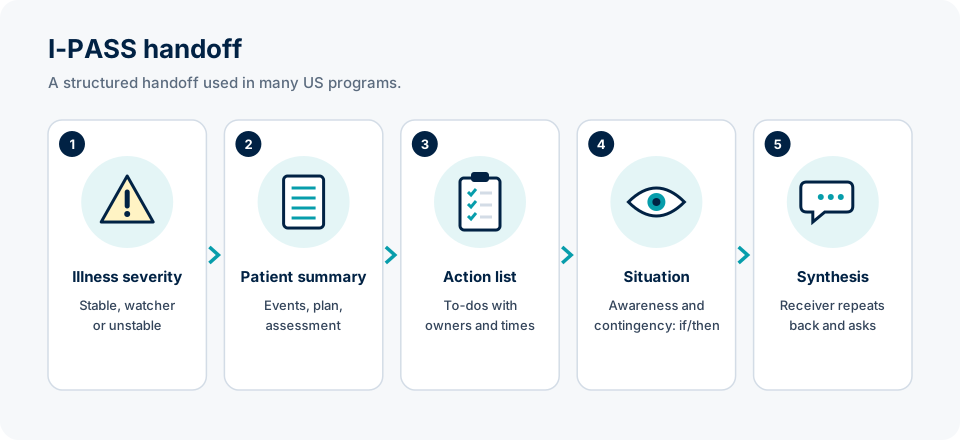
Handoffs: I-PASS
Handoffs are a major source of error. The I-PASS method, studied in a multicenter trial published in the New England Journal of Medicine in 2014 that found fewer preventable adverse events after it was introduced, structures them:
- Illness severity: stable, “watcher,” or unstable
- Patient summary: summary statement, events, ongoing assessment and plan
- Action list: to-dos, with who and when
- Situation awareness and contingency planning: “If her pressure drops below 90, give a 500 mL bolus and call me.”
- Synthesis by receiver: the receiver summarizes and asks questions
Calling for help: SBAR
Situation (“I'm calling about Mr. Lee in 412, who is newly hypoxic to 86%”), Background, Assessment (“I'm worried about pulmonary edema”), Recommendation (“Can you come see him now?”). Lead with the reason you're calling.
Key terms · tap to flip
Check your understanding
Knowledge check
Pick an answer to see the explanation. Get them all right to complete the lesson.
Part of the free MedRise US Clinical Etiquette & Communication for IMGs. Built on ACGME core competencies, AHRQ TeamSTEPPS, I-PASS handoffs and federal language-access rules.