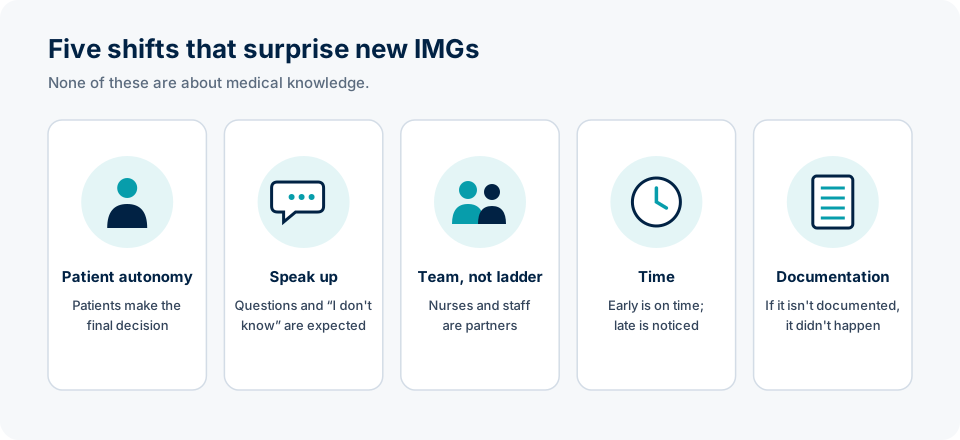
1. The patient decides
In many health systems the physician, or the family, makes the key decisions. In US practice, adult patients with decision-making capacity have the legal and ethical right to accept or refuse care after being informed. Your job is to explain the options, risks and benefits clearly, make a recommendation if asked, and respect the choice. Families are involved as much as the patient wants, not more.
2. Speaking up is a skill they grade
Many IMGs come from settings where questioning a senior is disrespectful. In US teaching hospitals, silence is often read as disengagement or not knowing. Expected behaviors:
- Ask questions at appropriate times.
- Say “I don't know, but I'll find out” and then find out.
- Raise safety concerns immediately, to anyone, at any level.
- Commit to an assessment and plan when presenting, rather than listing possibilities.
3. A flatter team
Nurses, pharmacists, respiratory therapists and case managers are colleagues with expertise, not subordinates. A nurse who calls about a patient is often the first to notice deterioration. Learn names, say thank you, and close the loop.
4. Time and reliability
Arriving early for pre-rounds, finishing tasks you said you'd do, and telling people when you can't are core professional behaviors. “I will have that done by noon” followed by doing it by noon builds more trust than brilliance on rounds.
5. Documentation and accountability
The medical record is a legal document. Notes must be accurate, timely and your own. Never copy forward findings you didn't examine, and never sign or document under someone else's name.
Mindset: none of this asks you to give up your culture. It's code-switching for a new setting, the same way you adapt to a new language.
Key terms · tap to flip
Check your understanding
Knowledge check
Pick an answer to see the explanation. Get them all right to complete the lesson.
Part of the free MedRise US Clinical Etiquette & Communication for IMGs. Built on ACGME core competencies, AHRQ TeamSTEPPS, I-PASS handoffs and federal language-access rules.