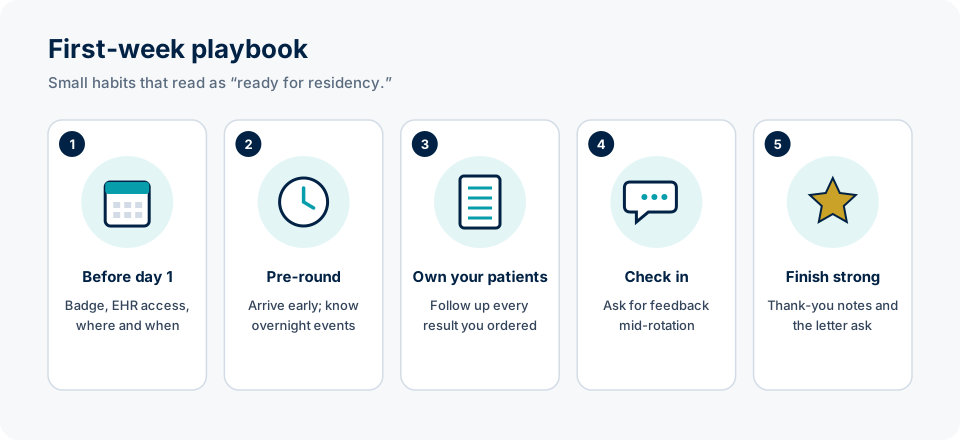
Before day one
- Confirm location, start time, who to report to and their contact.
- Complete required trainings (often HIPAA, bloodborne pathogens and others) and bring proof.
- Know your observer or student rules: can you examine patients? Write notes? Enter the operating room?
- Dress code: business casual with a white coat if allowed, closed-toe shoes, ID badge visible. Avoid strong perfume.
- Practice your introduction and your one-liner format.
Your daily routine
- Arrive 15 to 30 minutes before pre-rounds.
- Check overnight events, vitals and new results for your patients.
- See your patients before rounds if you're allowed.
- Present concisely, commit to an assessment and plan.
- Write down every task; close each loop and report back.
- Read for 30 minutes each evening about your patients' problems.
- Before leaving, ask the resident: “Is there anything else I can help with before I go?”
The faux pas list
- Arriving late or leaving without telling the team
- Using your phone on rounds or at the bedside for non-clinical things
- Letting a patient think you're the doctor when you're a student or observer
- Arguing with feedback, or comparing everything to “how we do it at home”
- Talking about patients in elevators or cafeterias
- Taking photos of screens, charts or patients on your phone
- Asking about letters on your first day
- Ignoring nurses' calls or speaking rudely to staff
Small things are remembered. Learning the unit clerk's name, refilling the printer you emptied, and thanking the nurse who taught you something are what people mention when they write about your professionalism.
Finish strong
In the last week, ask the attending who knows your work best whether they feel they could write a strong letter. Give them your CV, personal statement draft, the dates you worked together and two or three patients you discussed. Send a short thank-you note to the team.
Review
- Patients decide; you inform, recommend and respect.
- Name and role every time; plain language; titles until invited otherwise.
- One-liner, SOAP by problem, commit; I-PASS and SBAR.
- Consent is a conversation; capacity is decision-specific.
- Qualified interpreters; teach-back.
- CUS, two-challenge rule, closed loop, time-outs, report errors.
- Ask for feedback, take it gracefully, keep boundaries, protect your wellbeing.
Key terms · tap to flip
Check your understanding
Knowledge check
Pick an answer to see the explanation. Get them all right to complete the lesson.
Part of the free MedRise US Clinical Etiquette & Communication for IMGs. Built on ACGME core competencies, AHRQ TeamSTEPPS, I-PASS handoffs and federal language-access rules.