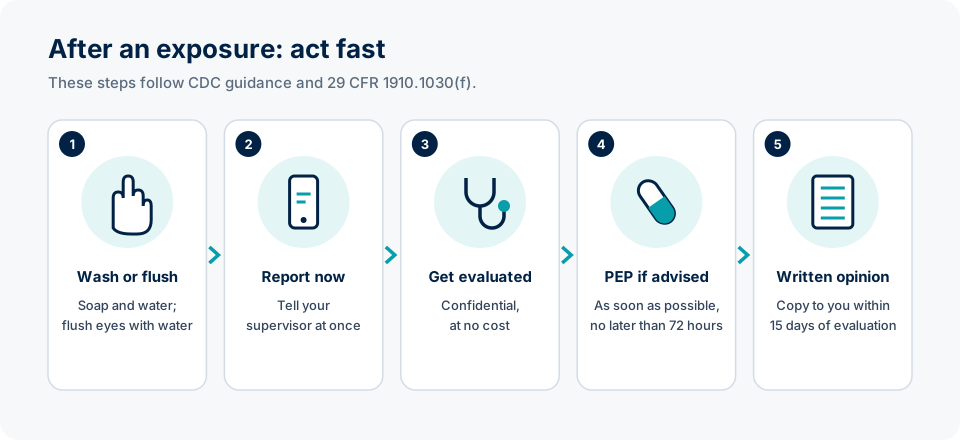
If it just happened: stop reading after step 1, wash the area now, then come back.
- Wash or flush right away. Wash needlesticks and cuts with soap and water. Flush splashes to the nose, mouth or skin with water, and irrigate eyes with clean water, saline or sterile irrigant. Don't squeeze the wound or use bleach.
- Report it immediately. Tell your supervisor, preceptor or the charge nurse now, not at the end of the shift. Students and observers: also tell your school or program contact. Early reporting is what gets you fast care.
- Get a medical evaluation the same day. Go to employee health or the emergency department. The evaluation is confidential, and for employees it is at no cost. It covers the route of exposure and the source patient's HIV, hepatitis B and hepatitis C status, if known or testable with consent.
- Start HIV PEP fast if it is recommended. If HIV post-exposure prophylaxis is recommended, start it as soon as possible, ideally within 24 hours and no later than 72 hours. Don't wait for the source patient's results.
- Follow up and keep your records. Expect follow-up testing over the next months. Your employer must give you a copy of the healthcare professional's written opinion within 15 days of the evaluation, and your medical records stay confidential.
Why speed matters
Most needlesticks never cause infection, but the first hours decide your options. Hepatitis B can be prevented after exposure in people who are not immune, and HIV PEP works best when it starts early. Reporting also creates the record you need for follow-up care and, for employees, for workers' compensation.
Prevent the next one
Use safety-engineered sharps, never recap with two hands, and drop used sharps into a sharps container within reach. These rules come from OSHA's Bloodborne Pathogens Standard, 29 CFR 1910.1030, which also requires employers to train staff every year.
Learn it once, properly. MedRise's free Bloodborne Pathogens Training covers exposure response, PPE, hepatitis B vaccination and more in 11 short lessons, with a $6.99 verifiable certificate if you need one for work or rotations.
Start the free course Try the practice testQuestions people ask
What is the risk of HIV from a needlestick?
Low. CDC estimates the average risk after a needlestick from a source with HIV is about 0.3% (about 1 in 300), and lower when the source has an undetectable viral load. The risk for hepatitis B is much higher if you are not immune, which is why the hepatitis B vaccine matters.
Should I squeeze the wound to make it bleed?
No. Wash it with soap and water. Squeezing or using bleach or other harsh chemicals is not recommended.
I'm a medical student. Who pays for my evaluation?
It depends on your school and the hospital. Many schools have a needlestick policy and insurance coverage for students. Report first, get evaluated, and sort out billing afterward: delays matter more than cost.
How fast do I need to act?
Right away. Wash, report and get evaluated within hours. HIV PEP, if recommended, works best when started as soon as possible and no later than 72 hours.
Education only, not medical advice. Follow your workplace exposure plan and your clinician's advice. Sources: OSHA 29 CFR 1910.1030(f); CDC/NIOSH occupational exposure guidance.