Hepatitis B: your titer is your shortcut
The management of a hepatitis B exposure depends on your immunity:
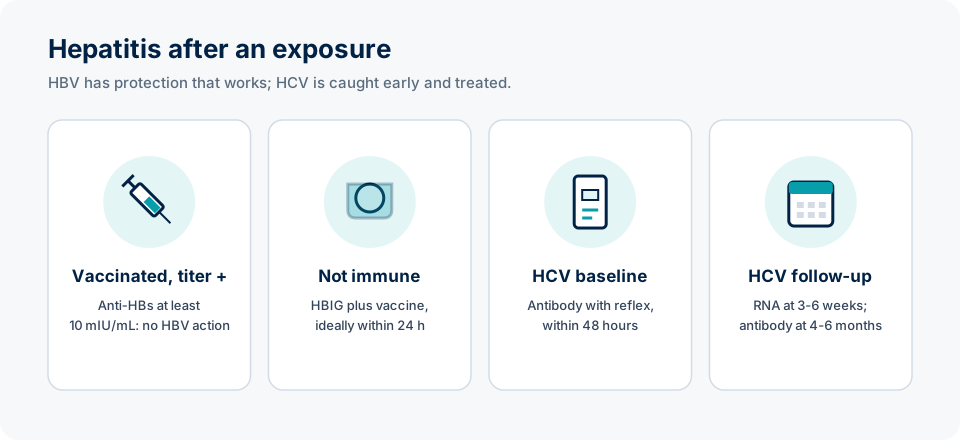
- Documented responder: you completed the vaccine series and had anti-HBs of at least 10 mIU/mL at some point. No post-exposure testing or treatment for hepatitis B is generally needed.
- Not vaccinated, incompletely vaccinated, or a documented non-responder: if the source is HBsAg-positive (or unknown and high-risk), the clinician may give HBIG and start or continue the vaccine series, as soon as possible and ideally within 24 hours.
- Vaccinated but response unknown: you'll be tested for anti-HBs, and management depends on the result and the source's status.
Do this before your first rotation: find your hepatitis B vaccine record and your anti-HBs (titer) result, and keep a photo of both on your phone. It can turn a stressful night into a quick visit.
Employees with occupational exposure must be offered the hepatitis B vaccine at no cost (29 CFR 1910.1030(f)(2)).
Hepatitis C: test, catch early, treat
There is no post-exposure prophylaxis for hepatitis C. CDC's 2020 guidance for health care personnel:
- Baseline: test the exposed person for HCV antibody with reflex to HCV RNA, as soon as possible, preferably within 48 hours, which can be done alongside the source's testing.
- If the source is HCV RNA-positive (or antibody-positive with RNA unavailable, or status unknown): test the exposed person for HCV RNA at 3 to 6 weeks.
- If RNA is negative at 3 to 6 weeks: a final HCV antibody test at 4 to 6 months.
- Anyone found HCV RNA-positive is referred to care; current treatments cure most infections.
Same visit, three viruses
A single evaluation covers HIV, HBV and HCV together, and the follow-up schedules can often be lined up so you don't need extra blood draws.
Key terms · tap to flip
Check your understanding
Knowledge check
Pick an answer to see the explanation. Get them all right to complete the lesson.
Part of the free MedRise Exposure Response & PEP Training. Built on OSHA 29 CFR 1910.1030(f), the 2025 U.S. Public Health Service occupational HIV PEP guidelines and CDC hepatitis guidance.