Who arranges it
Your employer's exposure process (for employees, under 29 CFR 1910.1030(f)(3)) identifies the source individual when feasible and arranges testing for HIV and hepatitis B and C as soon as possible after consent is obtained, unless the source's status is already known. Consent rules for source testing differ by state; occupational health handles this, not the exposed worker.
The tests
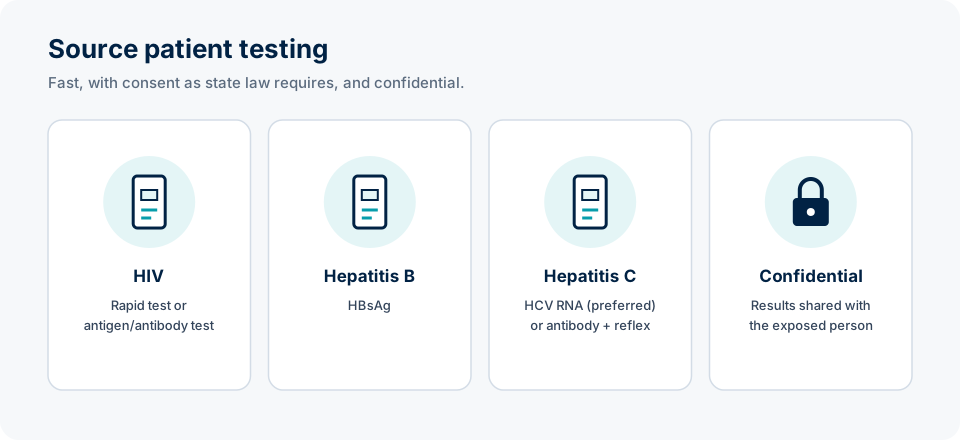
- HIV: a rapid HIV test or a laboratory antigen/antibody test.
- Hepatitis B: hepatitis B surface antigen (HBsAg).
- Hepatitis C: CDC's 2020 guidance prefers testing the source with a nucleic acid test for HCV RNA, especially when the source may have been recently infected (for example, injection drug use in the past 4 months). The alternative is an HCV antibody test with reflex to RNA if positive. Source testing should happen as soon as possible, preferably within 48 hours.
Never test the needle. Testing needles or other sharps is not recommended: results are unreliable and handling the device creates another injury risk.
Why PEP doesn't wait
HIV PEP should start as soon as possible, up to 72 hours, after a significant exposure. If the source's HIV status is unknown, the clinician starts PEP if indicated; under the 2025 guidelines, PEP and HIV follow-up testing are stopped if the source tests HIV-negative. Waiting for results can push you outside the window where PEP works best.
Confidentiality
Results of the source's testing are made available to the exposed person, who must be told about laws on disclosing the source's identity and infection status (1910.1030(f)(3)(ii)(C)). Never share them with anyone else.
When the source is unknown
If the source can't be identified, for example a needle in a trash bag, the clinician estimates risk from the setting and device and decides on PEP and follow-up.
Key terms · tap to flip
Check your understanding
Knowledge check
Pick an answer to see the explanation. Get them all right to complete the lesson.
Part of the free MedRise Exposure Response & PEP Training. Built on OSHA 29 CFR 1910.1030(f), the 2025 U.S. Public Health Service occupational HIV PEP guidelines and CDC hepatitis guidance.