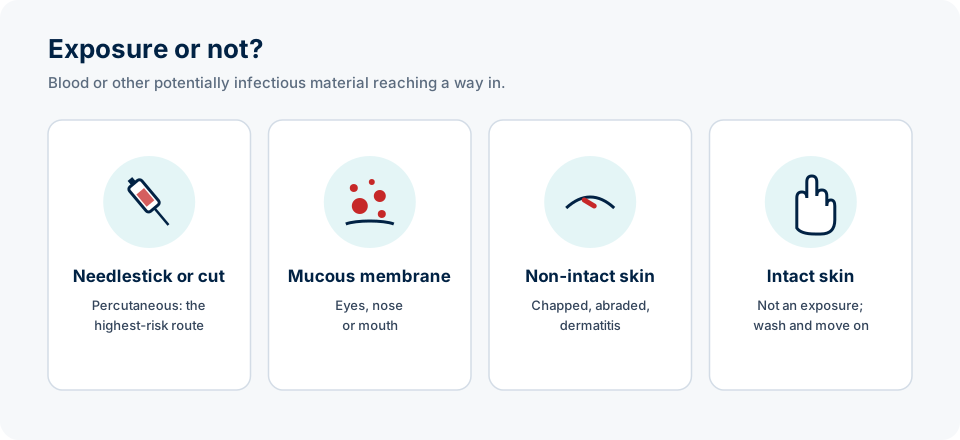
The three routes that count
- Percutaneous: a needlestick or cut from a sharp contaminated with blood or other potentially infectious material (OPIM).
- Mucous membrane: a splash to the eyes, nose or mouth.
- Non-intact skin: contact with skin that is chapped, abraded, cut or affected by dermatitis.
OPIM includes semen, vaginal secretions, cerebrospinal, synovial, pleural, pericardial, peritoneal and amniotic fluid, saliva in dental procedures, and any body fluid visibly contaminated with blood (29 CFR 1910.1030(b)). Non-bloody urine, feces, vomit, sweat and tears are not considered infectious for HIV.
The real risks
CDC estimates:
- HIV: about 0.3% (roughly 1 in 300) after a needlestick from a source with HIV; about 0.09% after a mucous membrane exposure. Risk is lower when the source has an undetectable viral load and higher with deep injuries, visible blood on the device, or a needle that was in a vein or artery.
- Hepatitis C: about 0.2% after a percutaneous exposure to an HCV-positive source, in CDC's 2020 review.
- Hepatitis B: much higher for a person who is not immune; risk depends on the source's markers and can be well above HIV's. For a vaccinated person with a documented antibody response, it is very low.
The point: most exposures never cause infection, but the steps in the next hours are what keep it that way. Don't panic, and don't skip anything.
Higher-risk features
Hollow-bore needles that held blood, deep punctures, visible blood on the device, and devices that were in a vein or artery carry more risk than a solid suture needle or a superficial scratch. The clinician evaluating you will ask about each of these, so notice them.
Key terms · tap to flip
Check your understanding
Knowledge check
Pick an answer to see the explanation. Get them all right to complete the lesson.
Part of the free MedRise Exposure Response & PEP Training. Built on OSHA 29 CFR 1910.1030(f), the 2025 U.S. Public Health Service occupational HIV PEP guidelines and CDC hepatitis guidance.