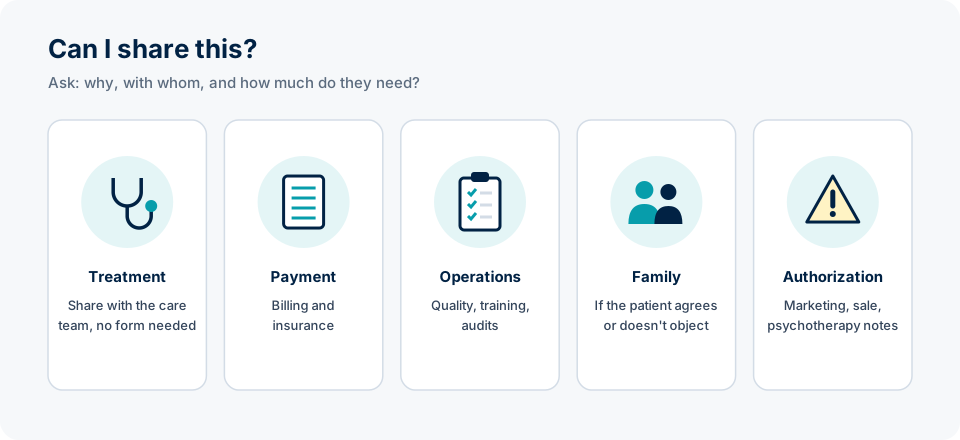
TPO: the everyday permission
Covered entities may use and disclose PHI for treatment, payment and health care operations without written authorization (45 CFR 164.506). Treatment includes consults, referrals and handoffs to another provider. Operations include quality improvement, audits and training students.
When you need an authorization
A signed authorization that meets 45 CFR 164.508 is required for uses outside TPO and the listed exceptions, and specifically for:
- Psychotherapy notes (a therapist's separate session notes), with narrow exceptions.
- Marketing, with narrow exceptions such as face-to-face communication.
- Sale of PHI.
There are also permitted disclosures without authorization for public interest purposes (45 CFR 164.512): public health reporting, reporting abuse or neglect as the law requires, health oversight, court orders, certain law enforcement requests, preventing a serious and imminent threat, and more. These go through the right office, usually not through you at the bedside.
Family and friends
You may share information relevant to someone's involvement in the patient's care or payment if the patient agrees, or is given the chance to object and doesn't, or, when the patient can't agree, if you judge it is in their best interest (45 CFR 164.510(b)). Ask the patient first when you can: “Is it okay if I talk about your results with your brother here?”
Minimum necessary
For most uses and disclosures, use, disclose and request only the minimum PHI needed for the purpose (45 CFR 164.502(b)). It does not apply to disclosures to a provider for treatment, to the patient, under an authorization, to HHS, or when required by law.
Minimum necessary in practice: open the charts of patients you're caring for, and the parts you need. Print the sign-out list, not the full chart. In the elevator, say nothing identifiable.
Incidental disclosures
If someone overhears part of a bedside conversation even though you spoke quietly and closed the curtain, that is an incidental disclosure, and HIPAA allows it when reasonable safeguards and minimum necessary were applied. It doesn't excuse avoidable ones, like discussing a patient in the cafeteria line.
Key terms · tap to flip
Check your understanding
Knowledge check
Pick an answer to see the explanation. Get them all right to complete the lesson.
Part of the free MedRise HIPAA Privacy & Security Training. Built on the HIPAA Privacy, Security and Breach Notification Rules (45 CFR Parts 160 and 164).