Contents
On the medicine shelf, acute monoarthritis shows up as one hot, swollen, painful joint, most often a knee, in a patient with diabetes, rheumatoid arthritis, a prosthetic joint or a history of gout. The question almost always tests one move: tap the joint before you treat it, then read the fluid without letting crystals or a modest cell count talk you out of infection.
The algorithm
Steps 1 to 4 answer "is this joint infected?"; steps 5 to 8 treat it.
- Assume infection firstOne acutely hot, swollen joint is septic arthritis until the fluid says otherwise, because prompt treatment lowers morbidity and mortality. The knee is the most common site. Raise your suspicion for age over 80, diabetes, rheumatoid arthritis, recent joint surgery, a hip or knee prosthesis, skin infection, immunosuppressive drugs or injection drug use.
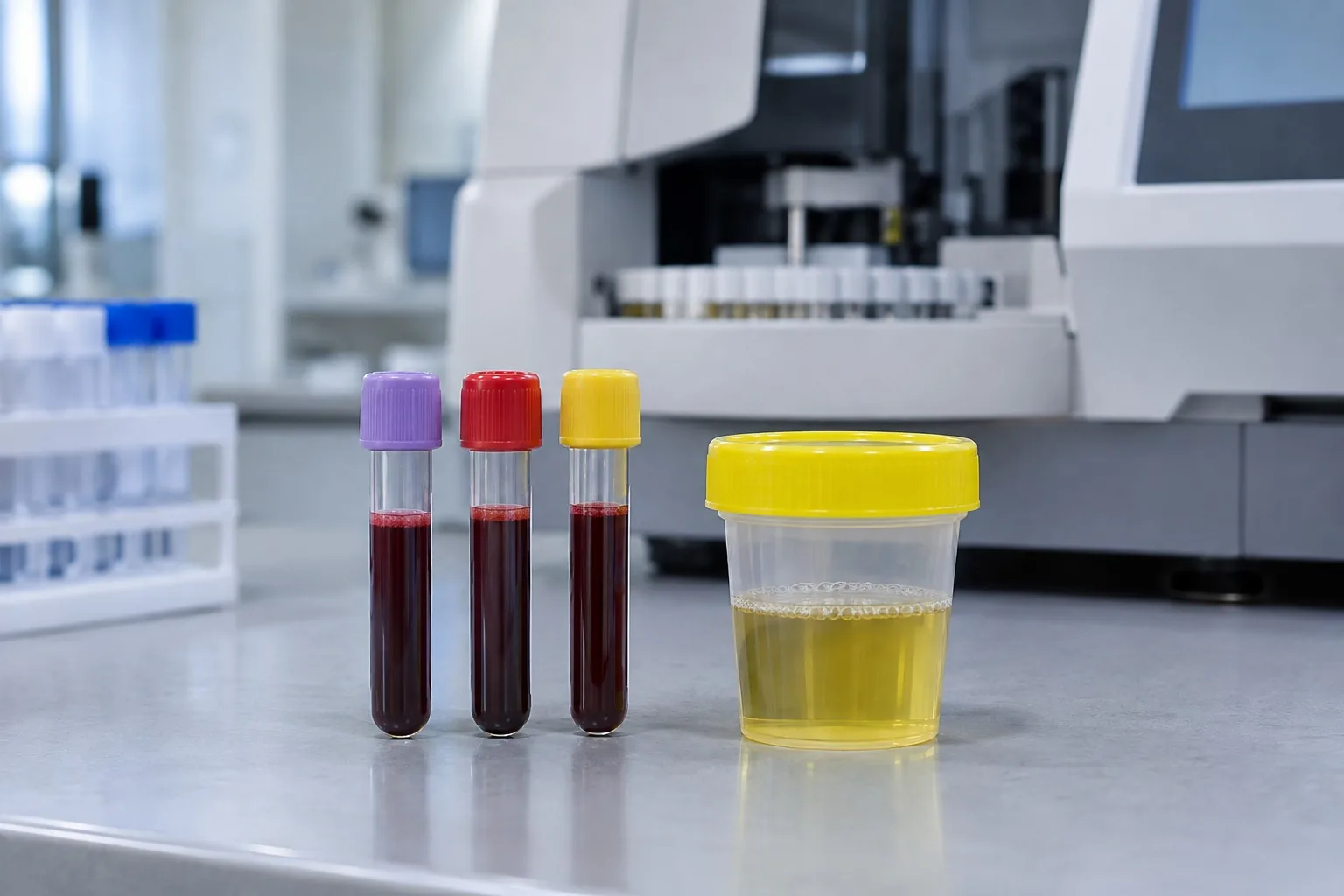
- Tap before antibioticsArthrocentesis is the deciding test. Send synovial fluid for cell count with differential, Gram stain, culture and crystal analysis. Use ultrasound guidance for hard-to-reach joints such as the hip, and draw blood cultures when bacteremia is suspected.
- Read the cell countBefore cultures return, the synovial WBC count and the percentage of neutrophils are the most useful results. A count above 50,000/µL (likelihood ratio about 7.7), and even more a count above 100,000/µL (about 28), points to infection, as do neutrophils of 90% or more (about 3.4). A count below 25,000/µL lowers the odds (about 0.32), but a count under 50,000/µL does not exclude septic arthritis.
- Read the crystals, then keep goingNeedle-shaped crystals with strong negative birefringence mean gout. Rhomboid or rod-shaped crystals that are weakly positively birefringent, or not birefringent at all, mean calcium pyrophosphate (CPP) disease. Crystals do not exclude infection, so the Gram stain and culture still decide.
- Start empiric antibiotics by the Gram stainCover Staphylococcus aureus, the most common pathogen, and streptococci. Gram-positive cocci: vancomycin. Gram-negative cocci: ceftriaxone. Gram-negative rods: ceftazidime, cefepime, piperacillin-tazobactam or a carbapenem. Negative Gram stain with strong suspicion: vancomycin plus ceftazidime or an aminoglycoside.
- Take a sexual historyIn a sexually active patient with tenosynovitis, petechial or pustular skin lesions on the hands or feet, and asymmetric joint pain, think disseminated gonococcal infection. Send NAAT and culture from every exposed urogenital and extragenital site, plus joint fluid and blood. Treat with ceftriaxone 1 g IV or IM every 24 hours, add doxycycline if chlamydia has not been excluded, and admit for initial therapy.
- Drain the jointAntibiotics go with drainage or debridement of the infected joint. In one report about 30% of patients ultimately needed surgery, including about half of those with shoulder or hip infections. A prosthetic joint uses lower fluid thresholds (scoring criteria count a WBC above 3,000/µL and neutrophils above 80%), so a modest count can still mean infection.
- Narrow and finish the courseTailor therapy to the culture. Total duration usually runs 2 to 6 weeks, and MRSA septic arthritis needs drainage or debridement plus 3 to 4 weeks of antibiotics. Gonococcal arthritis can switch to an oral agent guided by susceptibility testing 24 to 48 hours after substantial improvement, for at least 7 days in total.
Clue in the stem, next best step
| Clue in the stem | What it points to | Next best step |
|---|---|---|
| Older adult with diabetes, fever and a hot, swollen knee that hurts with any motion | Septic arthritis until proven otherwise | Arthrocentesis before antibiotics |
| Known gout, "feels like my usual flare," but febrile | Infection can mimic or coexist with a flare | Tap the joint; do not just treat the flare |
| Synovial WBC 120,000/µL with 94% neutrophils | Septic arthritis highly likely | Empiric IV antibiotics by Gram stain, plus drainage |
| Strongly negatively birefringent needles, WBC 60,000/µL, Gram stain pending | Gout, with infection not yet excluded | Follow the Gram stain and culture; treat as infection if suspicion stays high |
| Older patient, knee or wrist, weakly positive rhomboid crystals, calcified cartilage on x-ray | CPP disease (pseudogout) | Still check Gram stain and culture; calcification does not exclude infection |
| Sexually active 24-year-old with wrist tenosynovitis and pustules on the fingers | Disseminated gonococcal infection | NAAT and culture of all exposed sites, blood and joint fluid; IV ceftriaxone; admit |
| Gram-positive cocci in clusters | Staphylococcus aureus, including MRSA | IV vancomycin and drainage |
| Gram-negative rods in a patient who injects drugs | Gram-negative organisms, including Pseudomonas | Cefepime or ceftazidime (or piperacillin-tazobactam or a carbapenem) |
| Fever, a painful hip and refusal to bear weight | Septic hip | Ultrasound-guided arthrocentesis; surgery is often needed |
| Painful prosthetic knee, synovial WBC 4,000/µL with 85% neutrophils | Possible periprosthetic joint infection | Apply prosthetic-joint criteria, not native-joint cutoffs |
Where students lose points
- Giving antibiotics before the tap. Aspirate first so the Gram stain and culture can name the organism, then start empiric therapy.
- Stopping at the crystals. Urate or CPP crystals explain inflammation but do not exclude a coexisting infection.
- Feeling safe with a count under 50,000/µL. Lower counts are common with atypical organisms and prosthetic joint infection.
- Ordering imaging or a serum uric acid first. Neither tells you whether the joint is infected; only the fluid does.
- Testing only the urethra or cervix for gonorrhea. Sample every exposed site, including the rectum and pharynx, and cover chlamydia with doxycycline unless it has been excluded.
Practice question
A 67-year-old man with type 2 diabetes and gout comes to the emergency department with 1 day of right knee pain and swelling. His last gout flare, in the left big toe, was a year ago, and he says this feels similar. He has had no injury. Temperature is 38.4°C (101.1°F), pulse 104/min and BP 132/80 mm Hg. The right knee is warm with a large effusion, and passive motion is very painful. There is no rash. Serum WBC count is 13,800/µL, C-reactive protein 9.2 mg/dL and creatinine 1.1 mg/dL. A knee x-ray shows an effusion and no fracture.
Which of the following is the most appropriate next step?
- Start oral colchicine and reassess in 48 hours
- Measure the serum uric acid level
- Arthrocentesis with cell count, Gram stain, culture and crystal analysis
- MRI of the right knee
- Start oral cephalexin and arrange follow-up in 1 week
Show the answer
Answer: C. A febrile patient with diabetes and one hot, swollen knee has septic arthritis until the joint fluid says otherwise. Arthrocentesis gives the cell count, Gram stain and culture that decide whether the joint is infected, and crystal analysis shows whether gout or CPP disease is present. A gout history does not protect him: crystals and infection can coexist.
Why the others are wrong. A: treating a presumed flare skips the test that excludes infection. B: a serum urate level cannot tell you whether this joint is infected. D: imaging delays the one test that changes management. E: oral antibiotics without a culture can mask the organism and undertreat a septic joint.
60-second recall
Say each answer out loud before you reveal it, then mark yourself. Retrieval, not rereading, is what makes it stick.
1Synovial WBC with a likelihood ratio near 28 for septic arthritis
Above 100,000/µL.Did you get it?2Do crystals in the joint fluid exclude infection?
No; infection can coexist with gout or CPP disease.Did you get it?3Most common organism in adult septic arthritis
Staphylococcus aureus.Did you get it?4Empiric drug when the Gram stain shows gram-positive cocci
IV vancomycin.Did you get it?5Regimen for gonococcal arthritis
Ceftriaxone 1 g IV or IM every 24 hours, at least 7 days in total.Did you get it?
Make retrieval a habit on every topic with Learning to Learn Medicine. Module 1 is free; the full bundle (the course plus all 12 Recall Labs) is a one-time $199.
Next: browse every Board Review post, work through today's other guide, the mitral stenosis vs left atrial myxoma algorithm, review the initial vs best diagnostic test pairs, present a case with MedRise Viva, or see MedRise for students. Test yourself with today's Daily Case on Instagram @medrise_ at 7:30 PM Central, and hear it worked through on the MedRise Podcast.
Sources
- Earwood JS, Walker TR, Sue GJC. Septic arthritis: diagnosis and treatment. Am Fam Physician, 2021
- Margaretten ME, et al. Does this adult patient have septic arthritis? JAMA, 2007 (PubMed)
- CDC. Gonococcal infections among adolescents and adults. Sexually Transmitted Infections Treatment Guidelines, 2021
- Lehman B. Acute infectious arthritis. Merck Manual Professional Edition, reviewed 2026
- Keller SF. Calcium pyrophosphate deposition disease. Merck Manual Professional Edition, reviewed 2025
- Microscopic examination of crystals in joints. Merck Manual Professional Edition, 2026
MedRise Board Review is educational content for exam preparation only. It is not medical advice and does not replace current guidelines, your school's materials or clinical judgment.