🫀 Cardio Question: Empiric Antibiotics in Prosthetic Valve IE
A 65-year-old man with a mechanical mitral valve presents with fevers, night sweats, and malaise. Blood cultures are pending. He had his valve placed 4 months ago. TEE reveals a vegetation on the prosthetic mitral valve.
Which of the following is the most appropriate empiric antibiotic regimen?
A) Vancomycin + Gentamicin
B) Vancomycin + Cefepime + Rifampin
C) Ampicillin + Ceftriaxone
D) Vancomycin + Piperacillin-Tazobactam
E) Linezolid + Ceftriaxone + Gentamicin
✅ B) Vancomycin + Cefepime + Rifampin
🧠 Here's Why:
This is early-onset prosthetic valve endocarditis (PVE) — occurring within 12 months of valve replacement.
💣 In early PVE, we worry about:
Staph aureus (MSSA/MRSA)
Staph epidermidis (coag-neg Staph)
Gram-negatives (e.g. Pseudomonas)
Fungal
Resistant organisms from the OR
🔬 Empiric regimen must cover:
MRSA → Vancomycin
Gram-negative rods (including Pseudomonas) → Cefepime
Biofilm on prosthetic material → Rifampin (excellent penetration + synergy)
💡 Key PVE Rules:
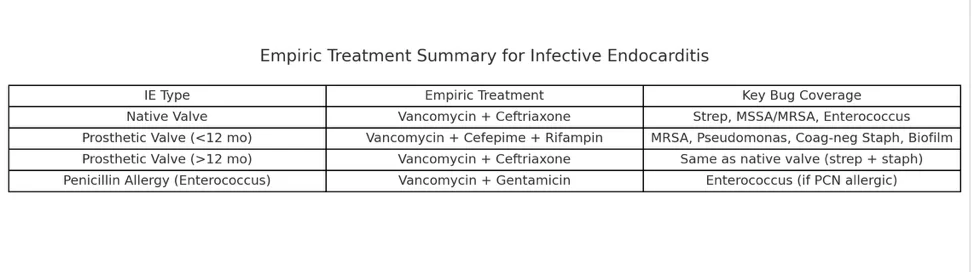
Why not the others?
A) Vanc + gent = native valve, not broad enough for early PVE
C) Amp + ceftriaxone = good for enterococcus, not prosthetic valve empiric tx
D) Vanc + pip-tazo = OK for sepsis, not prosthetic valve IE (no rifampin)
E) Linezolid = not first-line and doesn't replace vanc for IE